
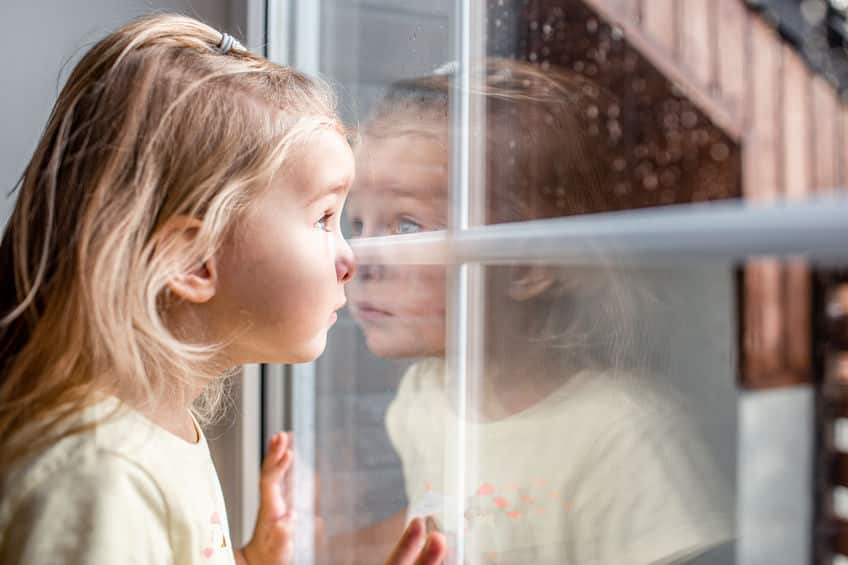
I’m looking at the tree outside my bedroom window and a lot, a lot of time passes. I don’t feel like moving, or doing anything. I can’t say what I have, or what’s wrong with me. My body feels tired, but I haven’t done anything. My toys are all on the furniture; I used to like playing with them, but now I don’t care and I don’t feel like using the tablet either. My mother has already come in several times and said to me, “What are you doing standing there like a dummy?” I didn’t quite know what to answer her. She’s always running around and doing things very quickly; she works a lot outside and inside the house.
My little brother is a pain to everyone, and my mother says, “This child is driving me crazy.” My father spends little time at home; he always has work to do outside. My grandfather used to say to me, “Don’t worry, darling, even if your parents are very busy, you and I can do so many things together, and you know we have a lot of fun.” Now my “grandpa” is gone forever, like my turtle was; they’ve already explained to me that it’s normal, but I miss him so much… and I miss his words, his hugs, his stories, his games… I see his things, and I don’t fully understand why it had to be this way. My brother seems to care less.
When night comes, I don’t know why I’m scared, and I have trouble sleeping, and when I finally do, monsters appear, and I wake up sweaty and with so much anguish.
I used to like school, and I was doing well, but now I’m not interested. It’s not like when I’m bored; it’s different; I just don’t care. In many classes, I don’t understand; the bell rings, and I don’t know what the teacher has explained. My friends want me to play with them in the yard, and I do, but like a robot; they get angry with me because they say I don’t understand and that I’m in the clouds. I miss my best friend Fran a lot; he moved to another city last year; we talk on the phone, sometimes have a video conference, but it’s not the same. I do athletics; I used to like it a lot, and also competing, but now when my teacher yells at me, I get a pain in my chest and a knot in my stomach, and I just want to go home and go into my room without anyone talking to me.
Mom tells me that I’m getting weirder every day and that I have “very little patience” because I get angry easily and everything bothers me. I would like to talk to Mom and Dad and tell them that I’m not well, that I don’t know or understand what’s happening to me, that I don’t know how to explain it well either, that I’m afraid of staying like this forever, but they have very little time for anything, and what’s happening to me is strange; I also don’t want them to think they have a “touched” son.
The above is not a mere story; depression (low mood), although it seems difficult to accept, not only exists and is suffered by minors, children, and adolescents, but is also being verified from the Covid-19 pandemic an increase to almost 90%, in addition to other psychiatric ailments that are not the subject of this article. Childhood and youth are not protective filters against sadness, anguish, discouragement, apathy, anhedonia, abulia, anxiety, changes in the circadian cycle and sleep, self-harming ideas. Nor can or should the maxim that time heals everything and that it will pass be applied, because children overcome everything.
Symptoms of depression in children
The symptoms of depression vary according to the child’s personality and the stage of development in which they are. The Sant Joan de Déu hospital (Barcelona) lists the following:
The main symptoms are:
- Irritable or sad mood. Children are usually more irritable or moody than sad or dejected.
- Loss of interest or pleasure. They spend less time on hobbies or activities that previously gave them pleasure. Parents often notice greater social isolation or abandonment of hobbies that they previously enjoyed.
Other symptoms:
- Changes in appetite, with repercussions on weight (loss, gain, or stagnation)
- Changes in sleep (difficulty sleeping or excessive sleep)
- Psychomotor changes (difficulty staying still and moving continuously; or marked slowing in responses and movements)
- Feelings of worthlessness or guilt
- Fatigue, loss of energy
- Difficulty concentrating (for example, a sudden drop in academic performance, constant distraction, or memory complaints may be observed)
- Thoughts of death, suicide attempts
Keep in mind that many of the symptoms described are also characteristic of other types of difficulties or disorders; they are not exclusive to depression. They can appear in other psychological disorders, such as:
- Anxiety disorder: nervousness, psychomotor restlessness, somatic complaints, difficulty sleeping.
- Conduct disorders: behavioral or disciplinary problems
- Attention deficit hyperactivity disorder (ADHD): difficulty concentrating, low academic performance, low tolerance for frustration, low self-esteem
- Learning disorders: low academic performance, difficulty concentrating, low self-esteem
- School phobia: complaints of physical discomfort, agitation, low academic performance
- Lack of social skills: social isolation, misconduct, disciplinary problems
- Physical illnesses: complaints of physical discomfort, change in appetite, fatigue
- Eating disorders: increase or decrease in body weight, lack of weight gain / adequate growth, changes in appetite, low self-esteem
None of these symptoms, isolated or in a group, are solely indicative of depression. If some of these symptoms are present or you have doubts, consult a professional. If necessary, a mental health professional (clinical psychologist or psychiatrist) will be able to rule out these and other causes.
Observe the child and detect signs in their behavior
The causes of childhood depression can be varied. Risk factors
Let’s start with the cognitive style of the parents, which generates much discussion among experts, assessing that it is an interaction between genetics and education, with the minor acquiring a catastrophic tinge through vicarious learning. Parental conflicts or conflicts between the main attachment figures who raise the minor can also be a trigger.
With high incidence, child and adolescent depression is verified when there is family violence. The effect of stressful events (divorce of parents, deaths, moving, changing schools, losses…) should not be underestimated. When there is social rejection for whatever reason (physical, psychological, social characteristics…). And obviously due to intrinsic characteristics of the child, whether due to personality traits or other mental or neurodevelopmental disorders.
It is true that a depression that is not detected in time and on which no adequate intervention has been carried out can lead the child to present low self-esteem, low tolerance to frustration, generalized anxiety, learning problems and difficulties, problems in their social interactions and adaptations in the various vital areas (school, family, social). The difference between diagnosing in time and carrying out a treatment, with an average of five to seven months, and not doing so is that the child or young person is left with a problem that profiles him as a sad, pessimistic, isolated, withdrawn personality, with many insecurities and uncertainties, even with ritualistic and compulsive behaviors, apprehensive.
Observation of signs and early detection of childhood depression
Through dide, you, parents and teachers, can observe the signs of a possible childhood depression and obtain the information you need about the child in a broad spectrum of 35 markers that cover the main areas of the child and young person, that is, development and social, education and learning, emotion and behavior. All this without the intervention of the minor, since you are the adults who know the minor who, by observation (up to eight participants), respond easily and comfortably online to the interviews that will offer you information on the situation of the minor.
If the results indicate that everything is going well, fantastic, nothing to worry about other than continuing like this. However, if in the result a possible risk appears in any of the markers, it is facilitating you to lead the minor to the appropriate specialist so that they can give the best solution to the possible difficulty of the child or young person.
With only thirty minutes (in its longest extension) of your time dedicated to responding about the minor, whether you are a parent or teacher, you can allow the same quality of development and life, since gathering the extensive information about the minor with dide is how you can attend to their diversity and uniqueness for their greater psycho-evolutionary well-being.
If you are a father or mother and you are concerned about the behavior of your child, observe the signs and detect their needs with dide familia by clicking HERE.
The teachers and education professionals can detect signs of child and adolescent depression and other difficulties in all their students thanks to the observation of signs with dide education.
