
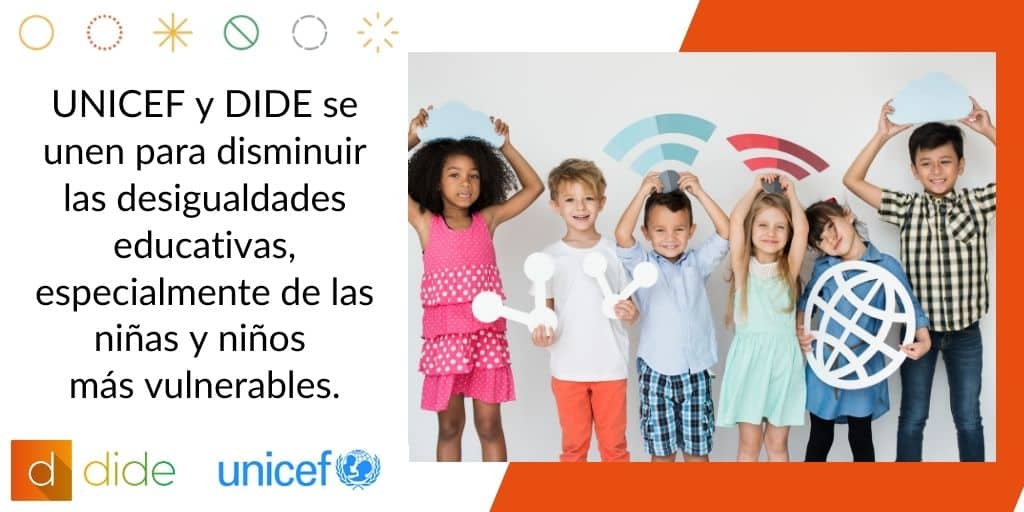
UNICEF and Grupo VS (dide) join forces to reduce inequalities, especially for the most vulnerable children.
The entities have signed an agreement to make available to educational centers 90,000 individualized studies for the early identification of learning and development difficulties in students.
These studies will contribute to alleviating the impact of COVID-19 on the Spanish educational system.
A society that wants to be fair cannot leave absolutely anyone behind. And that is achieved by equalizing opportunities in education. Unfortunately, this equality is not always present.
For this reason, and in order to eradicate the educational gap, UNICEF Spain and GRUPO VS, a Valencian company in the research, development and implementation of educational technological solutions, have today signed a collaboration agreement whereby educational centers linked to UNICEF will have free access to DIDE, a digital tool for the early identification of learning difficulties and recommended interventions.
We want to support children, their families and the educational community at this time when a new school year begins in a context that is especially complex due to COVID-19. (Javier Martos, executive director of UNICEF Spain).
“It is essential that educational centers can quickly identify the needs of their students in order to take the necessary measures to facilitate learning. Failure to detect the causes that provoke these difficulties in time will pave the way for future educational exclusion, increasing inequalities, especially for the most vulnerable children,” says Javier Martos.
The context of the pandemic has revealed the most urgent needs of the educational system. Providing resources and tools, such as the Dide platform, to educational centers will address the main challenges for thousands of students and will make it easier for centers to design and carry out a preventive and individualized intervention. This is essential to promote the learning of students with the most difficulties.
UNICEF Spain has urged educational administrations to strengthen tutorial action and early diagnosis measures and thus contribute to preventing school failure.
The objective of the Dide tool is to put the child as the central axis of the objective of the tool and identify their educational needs to help meet them with the support of specialists and the family. (Alberto Ramírez, director of Grupo VS)
“Knowing, understanding, preventing and supporting each child so that they can overcome their difficulties, whether social, behavioral, developmental or learning, is the essence that we share with UNICEF, and from which thousands of students will benefit thanks to this agreement,” explains Alberto Ramírez.
UNICEF Spain will provide Grupo VS with a list of 900 educational centers linked to the organization: Friendly Schools, Reference Centers in Education in Children’s Rights and educational centers in municipalities Friends of Children, who are interested in using Dide.

Centers that show interest will receive free access to the platform this school year 2020-2021
The tool detects and helps prevent 35 learning, development, social and behavioral needs of children and adolescents from 2 to 18 years of age and, once this analysis has been carried out, will provide reports with recommendations for families and teachers.
UNICEF considers that this “dide” tool can be useful in the educational center. In this way, they provide each center with the code through which they can obtain 100 free studies without any commitment. Only the educational professional must access the website dide.app, register and apply this code as a coupon. The educational center can carry out up to 100 tests on those students that they consider and under the selection criteria of the center.
The teachers of 900 educational centers throughout Spain will be able to carry out studies to learn more about their students. The teaching staff will fill in the data corresponding to each student, either in all dimensions or in some of them, and the system, after processing the information, will help them to detect and prevent up to 10 education and learning needs, 11 social development needs and 14 emotional and behavioral needs. Thus, this application collects information from multiple points of view and provides an individualized report with recommendations for both the family and the teaching staff.
These studies are a free assignment from Grupo VS to educational centers without any subsequent commitment to purchase or acquire the product. UNICEF only makes available to those interested centers a code as a coupon with which the educational professional can register their center and carry out 100 studies. Under no circumstances will UNICEF Spain be responsible for the content, development, commercialization, disposal or result derived from the use of the product.
If you want to know what the project consists of, listen to this interview with Aridane Hernández, Unicef technician in education in rights, Canary Islands. HERE
Join UNICEF’s petition to achieve a State Pact for Education
UNICEF Spain is concerned about a school year without an educational horizon, which is why they invite all their allies, the population and decision-makers to join the petition to ask all political leaders for a State Pact for Education that addresses the educational needs of each and every child and adolescent in Spain.
Sign here: https://www.unicef.es/pacto-estado-educacion

For more information about the dide project and obtaining the free code, consult with the UNICEF headquarters in your region or write to us at info@dide.app
September 22, 2020-.
