

In Spain today, there is little automation and connectivity in the work of educational counselors, and insufficient management and systematization of their time.
One of the objectives of díde educación is to make day-to-day educational guidance easier to stay in contact with students, families, and teachers.
In previous articles on our educational blog, we have addressed the topic of new technologies in relation to education. Until now, we have focused on issues associated with the risks involved in the use, by minors and younger people, of the different devices they have at their disposal. However, we want to positively highlight the benefits of these same information and communication technologies; in particular, on the applications they have for education and guidance professionals in the interest of equity and educational quality.
Current educational context
It is obvious that we need updated educational guidance professionals who respond to the real needs of today’s children and adolescents. Without forgetting that, as an underlying objective of the counselor, the well-being and development of these students, who tomorrow will be the soul and engine of our society, must prevail.
Different authors such as Majó and Marquès have insisted on the importance and influence of the information society on young people, as well as the need to integrate new technologies into the educational context.
Educational guidance professionals and experts agree with this trend and state that it is necessary to know the impact of the information society and apply it in the day-to-day of educational centers and schools. This was expressed to us by the attendees at the event organized by COPOE (Confederation of Psychopedagogy and Guidance Organizations of Spain) at the Ateneo de Málaga, where we presented the díde method, an innovative instrument that helps in the early detection of problems that hinder the learning and development of children and adolescents.
Educational guidance and the use of ICT. COPOE and Díde Conference
According to experts in this field, in Spain today, there is little automation and connectivity in the work of educational counselors and, on the other hand, insufficient management and systematization of their time.
It is very important to establish and implement prevention and management protocols in day-to-day life, systematize the mobility of student records, action protocols when difficulties are detected, and facilitate communication and connection between professionals, educational centers, and families.
We recently attended a conference on educational guidance today and all the speakers, and I would dare to say that almost all the attendees, agreed with what one of the speakers with almost thirty years of experience as a counselor pointed out; this is what he said: “We need professional procedures and instruments for professionals. Instruments that make our work more effective.”

In Grupo VS and with díde specifically, we have worked in this line so that the existing need in educational guidance becomes a possible and accessible reality.
It is now possible to streamline and coordinate these processes of prevention, detection and management of possible difficulties in the development and learning of children.
díde, as many of you already know, is a simple online platform, created by guidance and education professionals, that involves families and institutions in the early detection of any learning difficulty that negatively influences the development and education of the child and adolescent.
Several authors also agree that 21st century educational guidance models should facilitate the capacity for interaction and communication between educational agents and other members of the educational community, including families, institutions, and states. Therefore, the need to recognize the importance of ICT as tools that help promote contexts and new spaces that create synergies to communicate, create, and manage knowledge is clear.
Another current issue in congresses, talks, and articles is that there are too many occasions in which psychologists and educational counselors cannot prevent and detect early, cannot reach everything, and dedicate themselves, according to some professionals, to “putting out fires.” It is not about blaming anyone, since this is due to a multitude of causes (the student ratio, the budget of the educational center, the work methodologies, etc.). But due to this multicausality, a common effort is also crucial so that procedures are implemented that streamline and facilitate the work of counselors and can dedicate themselves to the commendable task of – continuing with the metaphor – keeping the mountain in good condition and carrying out preventive firebreaks.
That the day-to-day of the counselor means being able to be in contact with students, families, and teachers in a simpler way.
Undoubtedly, education and guidance assume new challenges day after day, society demands new requirements: pedagogical, technological and logistical, among others, but this transformation can be assumed positively with the capacity for adaptation and work in multidisciplinary teams that share the objective of achieving equity and equal opportunities, betting on innovation and educational quality.
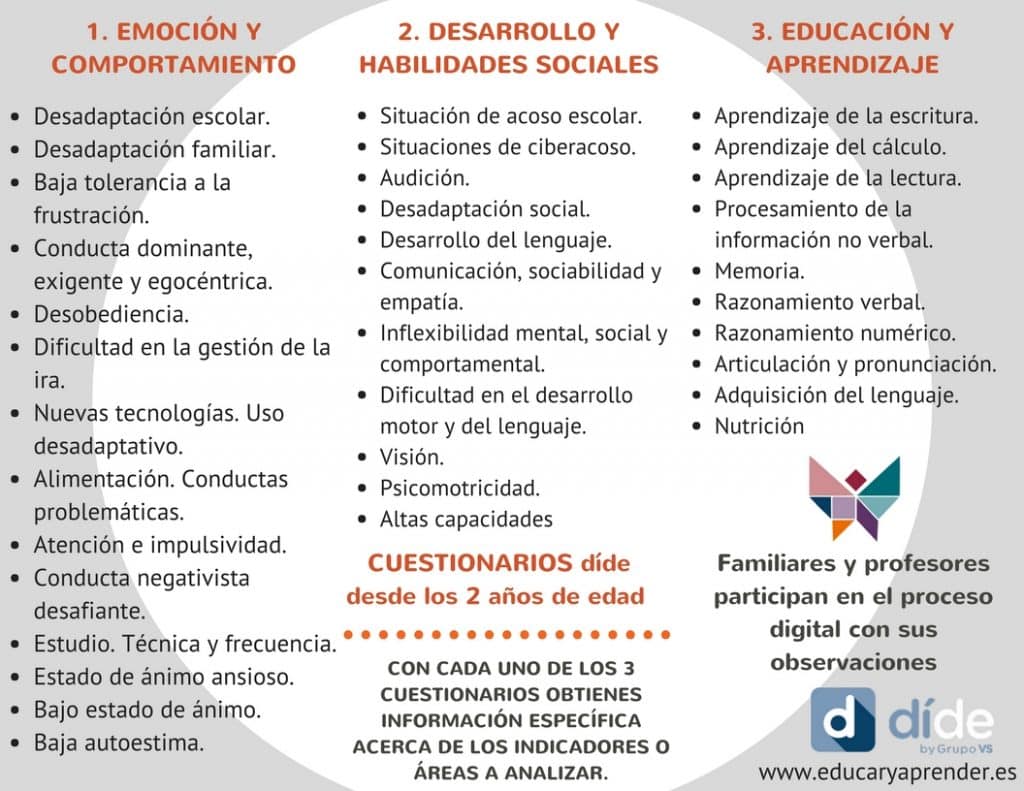

Join the educational evolution, it is necessary!, and with díde it is possible!