Seal of Excellence from the European Union
Dide receives the Seal of Excellence from the European Union in December 2019. This is a special recognition issued by the European Commission’s Research and Innovation Program for the years 2014-2020, Horizon 2020, to the project “Transforming differences into opportunities: Pioneering platform for the detection of learning and development difficulties.”
The awarding of this Seal by Corina Cretu, European Commissioner for Regional Policy, and Carlos Moedas, European Commissioner for Research, Science and Innovation, requires evaluation by a large number of independent experts from various countries, and is therefore a recognition of great international value.
The ambitious Valencian project of Grupo VS Ingeniería de Software has been classified as high quality after passing the strict evaluation criteria of the Horizon 2020 Program with respect to Excellence, Impact, Quality and Efficiency of Implementation. With a score of 13.30/15, this is a valuation process with a high rate of competitiveness.
After years of research and development by specialists in education, psychology and new technologies, our proposal is recommended by the European Union for funding from sources aimed at promoting psychoeducational innovation and technological development.
Dide project: objective, strategy and improvement plans
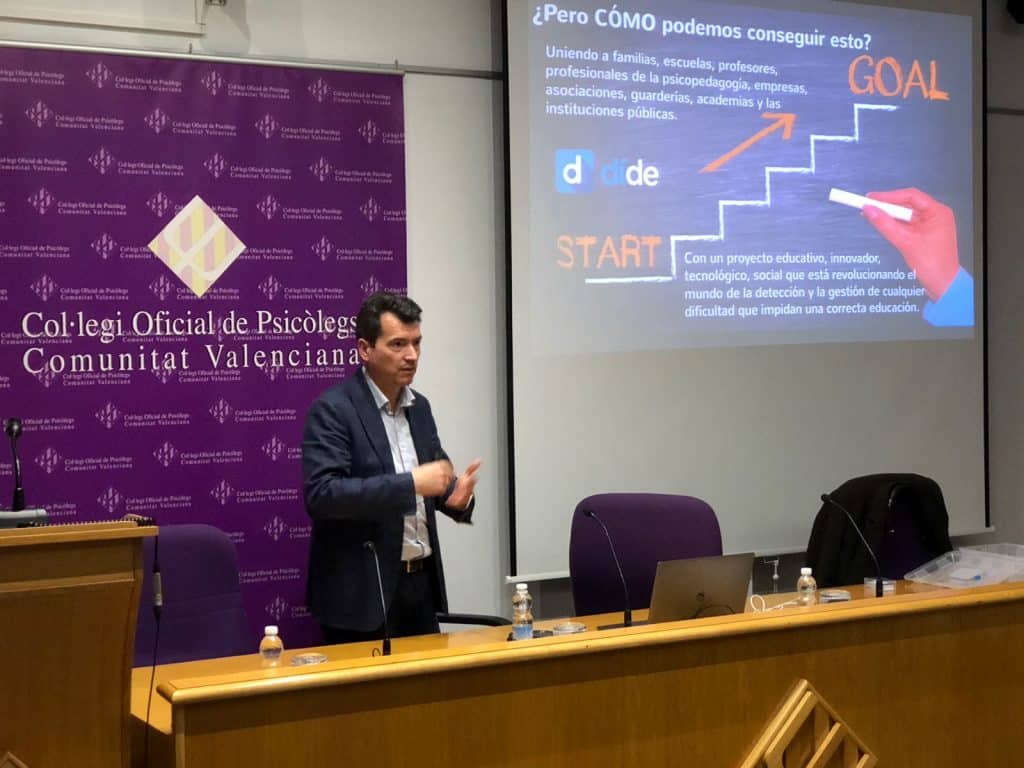
Dide is a new and revolutionary methodology for collecting information from the child’s environment to detect learning and development difficulties or problems that are present or could lead to a deficit or disorder. It is a unique online platform that serves as a support tool for psycho-pedagogical specialists and educational centers, ensures social equity in schools and provides families with a new concept of support tool for education, all without involving the child in the detection process.
Our goal is to make the dide comprehensive assessment available to all children, and parents, teachers and specialists are involved at the same time. Our business model is software as a service, easily scalable and flexible in pricing through pay-per-use or recurring subscriptions.
The pricing strategy is adapted to each stakeholder and is not an impediment to gaining traction in the market, while maintaining our social responsibility always on the right side of this commercial exploitation.
Our approach complies with 11 of the 17 sustainable development goals dictated by the 2030 agenda. We obtained 60 letters of support from governments, schools, associations, companies and other entities. The potential market is immense, offering three different versions to reach all possible stakeholders, from schools and governments to individual families, kindergartens, associations and companies.
We have an imminent need to expand our workforce. During the accelerator project, we are implementing applications to make the process of answering questionnaires even more accessible and easy to use. We are also updating and redesigning our user experience. At the same time, we are working to continue improving our data analysis by providing never-before-seen information: education trends and patterns for teachers and psycho-pedagogues, and useful information for governments and parents.
To detect means to perceive something that remains invisible or hidden. And this is the basis of the dide methodology.
It is obvious that the early detection of learning and development difficulties has an impact on the well-being and motivation of the child. Timely detection is a victory for the child, for his family and for the educational system, since it avoids situations that can end in school failure or emotional problems derived from the lack of specialized attention and guidance.
Dide is a methodology and an internet tool that facilitates a global vision of the profile of each child from 2 to 18 years of age.
Through digital questionnaires answered by parents and teachers (each from their device), information is collected on the minor, automatically identifying up to 35 indicators that influence their learning, development, emotion and behavior (dyslexia, dyscalculia, ADHD, asperger, autism, language disorders, demotivation, low self-esteem, school and family maladjustment, addiction to new technologies, study habits, eating disorders, bullying, high abilities…).

Information for parents: dide family
Information for schools and psycho-pedagogical cabinets
Since January 2020, Editorial Edelvives has become a distributor of the dide educational platform.