
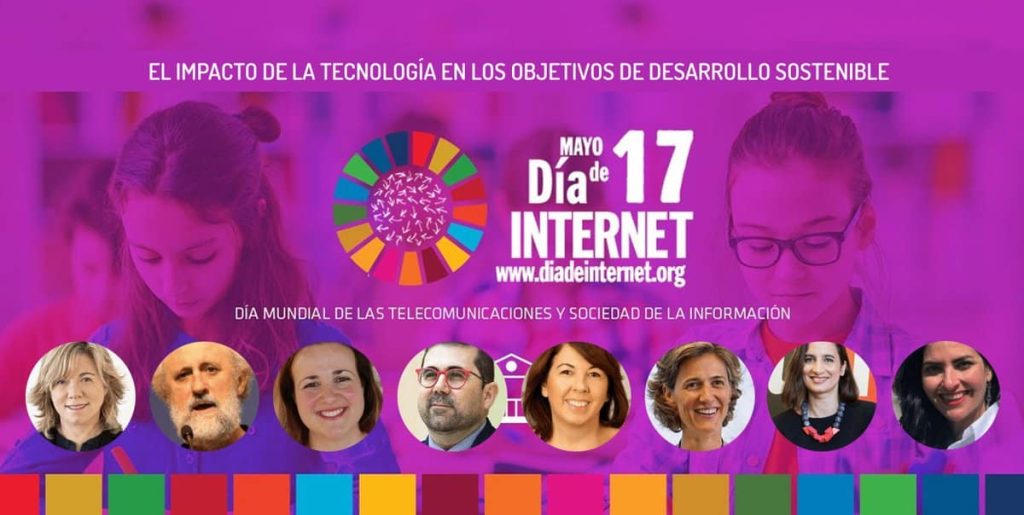
On World Internet Day, the impact of technology on the Sustainable Development Goals (SDGs)
The Senate and the Internet Day Promotion Committee, invite representatives from the political, business, media, cultural, and social spheres to the plenary debate held in the Senate, on May 17, World Internet Day, on “The impact of technology on the Sustainable Development Goals (SDGs)”
The plenary debate held in the Spanish Senate addressed how technology can help promote the Sustainable Development Goals (SDGs) promoted by the United Nations for 2030. The event included top-level speakers from the world of politics (Pilar del Castillo, Luis Cueto), companies (Telefónica, Facebook, and Google), and social organizations (Cibervoluntarios). Subsequently, the Personal Trajectory Award was presented to María Benjumea, creator of Infoempleo and Spain Startup South Summit.
The 17 Sustainable Development Goals are intended to be a global instrument to eradicate poverty and reduce inequalities and vulnerabilities, under the paradigm of sustainable human development. They constitute an ambitious and universal agenda “of the people, by the people, and for the people,” the main international development agenda for the period 2016-2030.
Can the internet help achieve these SDG goals?
The DIDE platform, an innovative educational tool that facilitates inclusion and equal opportunities among children, avoiding academic failure, is an example of how technology can invite society to take an active part in achieving these goals.

Goal 1: End poverty in all its forms worldwide
Dide helps reduce school dropout and failure rates and offers all children worldwide opportunities to opt for decent work, thereby enabling many millions of families to see in their children the possibility of escaping poverty and prospering.
Goal 2: End hunger, achieve food security and improved nutrition, and promote sustainable agriculture
It is intolerable that there are children with deficiencies who go to school without breakfast, or that there is a lack of training in nutrition and food in schools and families. Therefore, with Dide, we study these aspects in children and families.
Goal 3: Ensure healthy lives and promote well-being for all at all ages
Dide proposes to detect in time any difficulty in mental, behavioral, or social health that may impede proper training at any age from 2 to 18 years of age, and in any place.
Goal 4: Ensure inclusive, equitable, and quality education and promote learning opportunities for all
Dide has a very clear objective: it has been created to promote inclusive education, with equity and equal opportunities for all children. No child should be left out of the system due to a failure to detect their needs and difficulties.
Goal 8: Promote sustained, inclusive, and sustainable economic growth, full and productive employment, and decent work
Dide is committed to the economic growth of any country. If we reduce school failure and dropout rates considerably, the economy of a country would improve, giving opportunities to young people who do not have them today.
Goal 9: Build resilient infrastructure, promote inclusive and sustainable industrialization, and foster innovation
Dide was born from innovation between two sectors, from the technological to the educational and pedagogical. We do not know if we innovate to change the world, but we are sure that we change the world of many children and families.
Goal 10: Reduce inequality within and among countries and curb the increase in disparities
Dide promotes reducing inequalities between countries. If we manage to get students from a country to pursue higher education, employment and social opportunities would increase, reducing inequalities within the country as well as between countries.
Goal 11: Make cities and human settlements inclusive, safe, resilient, and sustainable
Dide believes in sustainable, community-based businesses that think first about the good of society and then about the business, but not the other way around. This is how we try to make a profitable company but, at the same time, with some social impact.
Early detection of learning and development needs and difficulties in children aged 2 to 18