
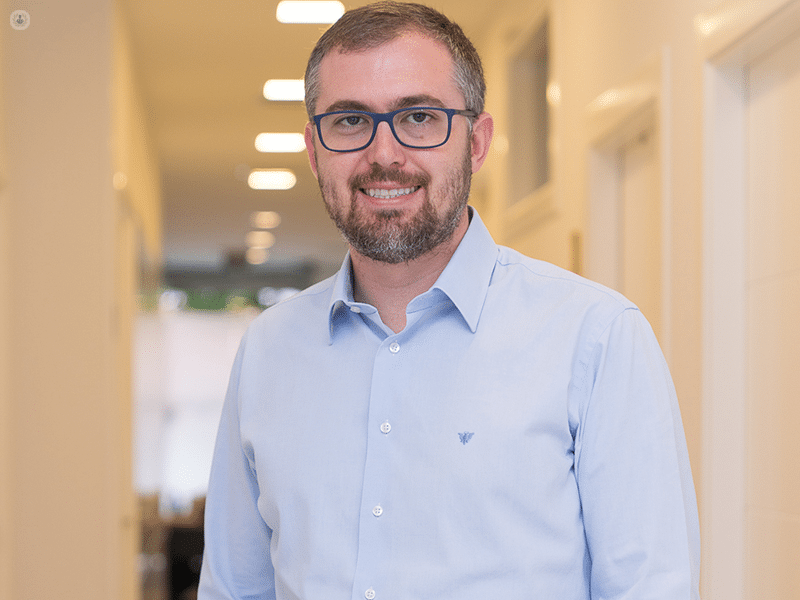
A neuropediatrician’s job is to promote the maximum possible development of people in all areas
A child neurologist or pediatric neurologist is a doctor who treats children with nervous system problems. Everything related to the child’s brain falls within pediatric neurology. This includes from the beginning of pregnancy to the end of development.
Nervous system problems can start in the brain, spine, nerves, or muscles. This can lead to problems such as seizures, headaches, or developmental delays. Early detection of behavioral, learning, and growth disorders is important to help the child develop correctly.
We spoke with Manuel Antonio Fernández, Neuropediatrician Expert in Learning and Behavior, (ADHD, Dyslexia…) Director of the INANP Center, Director of the Neuropediatrics Master’s Program, who granted us this interesting interview:
Manuel Antonio, what is the training of a neuropediatrician or child neurologist?
To become a pediatric neurologist, there is a long road. The most frequent route is through the specialty of pediatrics, so you have to do a medical degree (6 years), then prepare the MIR and get a place in Pediatrics (1 year), do the entire specialty of Pediatrics (4 years) and dedicate one more year to specializing in neurology in addition to the one you do within pediatrics itself at the end (1 year). Even so, the Spanish Society of Child Neurology asks you for more than 4 years of experience to give you the Official Accreditation.
It is hard to read all this, but despite so much work, the Ministry of Health does not officially recognize the specialty of Child Neurology within pediatrics as of today.
What are the main problems that the neuropediatrician works on?
As an example, I can highlight genetic disorders, epilepsy, childhood migraines, and many other things.
It is a very broad area that is still in the process of development in Spain. We are few neuropediatricians, and it is an area little known by other professionals in the health sector. I would dare to say more, the figure of the child neurologist is very little known among parents. Most do not even know that we exist, and of course, they are not clear in what situations we can help them.
Is there a difference between neurological problems and neurodevelopmental problems?
Indeed, neurodevelopmental disorders are a group of neurological problems associated with altered brain maturation in a child. Neurodevelopmental disorders include autism, mental retardation, hyperactivity, or anorexia, for example.
This issue is of great importance today since most consultations received in a pediatric neurology unit, whether public or private, are related to developmental problems like these.
Of the problems you work with, which ones cover a greater percentage? Which are diagnosed more frequently?
Within neuropediatrics, I have specialized in neurodevelopmental disorders. Most of the cases I deal with on a daily basis are children with Developmental Delay, Attention Deficit Hyperactivity Disorder, and Autism.
This group of disorders is one of the most frequent and also one of the ones that produces the greatest repercussions both for the child and for their family. In addition, because in most cases there are no alterations in the usual tests such as electroencephalogram, resonance, and the like, they are among the most difficult to evaluate and diagnose. And I fear that for the same reason, they are among the most misunderstood disorders.
Do you think that there is currently an increase in neurodevelopmental problems, or could it be that there is greater and earlier detection?
Indeed, that is the case. There are no more developmental disorders than there have always been in general. Evaluation techniques have advanced a lot. If we add to this the greater social awareness about these issues, we will find the answer to your question.
When we see that some studies show high numbers of children with developmental disorders, we have to ask ourselves about the criteria chosen for diagnosis. Today there is a much greater knowledge of this issue, and this means that these children are diagnosed much earlier and much better.
Are parents attentive and knowledgeable about the possible problems that their children present?
The truth is that in the last 10 years we have noticed very important changes in this issue. Parents have been and continue to be very attentive to how the evolution and development of their children occurs.
There is an increasing dedication on the part of families to these aspects, which means that cases reach us earlier, and we can avoid major complications.
The problem lies in the lack of information that parents have about the normal development process of a child. There is a lot of information on the internet, but not all of it is reliable. That is precisely why we launched our website elneuropediatra.es
It is the best way we have to promote a better understanding by parents of all aspects related to the neurological development of their children, so that they can detect alterations and anomalies.
We have created 3 free guides for parents grouping the three most relevant areas. With them, we hope to do our bit to help parents in their complex task of educating and raising their children.
-
- Learning or behavior problems: https://elneuropediatra.es/gratis-problemas-de-aprendizaje-y-conducta/
- Maturation or development problems: https://elneuropediatra.es/gratis-problemas-maduracion-y-desarrollo/
- Other neurological problems: https://elneuropediatra.es/gratis-otros-problemas/
In your experience, is there interaction and communication flow when detecting between the school and family environments?
In the vast majority of cases, there is a lack of knowledge in this regard on the part of teachers and those responsible, both the management of the center and the guidance team.
I fear that this is one of the biggest problems we usually encounter. I see every day in the consultation how there are centers where they directly ignore this type of difficulty. The most frustrating sensations occur when, even after a diagnosis, the centers refuse to intervene to establish methodological adaptation measures or support necessary for these cases. It is essential to advance training on these issues in the educational field. Until we achieve this, the 25% school failure rate that we suffer will never decrease.
Have you encountered cases of young people of advanced age and even adults who have not been diagnosed correctly due to lack of detection?
We are receiving more and more cases of this type. Teenagers whose parents tell you how their children have always had problems in their studies, poor concentration, and even clear school failure without anyone giving them an explanation of why or doing anything to solve it.
Most of these families come to us through two different channels. One of them is the recommendation of an acquaintance who has gone through the same situation until reaching our center. The other is after reading the information on our website. This shows that we still have a long way to go.
Have you perceived through your diagnosed minor patients if there has been an increase in bullying?
Bullying has become a true epidemic in 21st-century schools. It is likely that there is no increase in its frequency, but a radical change. This change has been derived from the existence of mobile phones and social networks.
This combination is devastating when it comes to causing harm to bullied people and, of course, makes it much easier to multiply the reach of any act of this type. School bullying has changed to leave the classroom and go to the networks. This requires drastic measures that the administration is not being able to implement.
Do you consider multidisciplinary collaboration and among all areas of the minor to be convenient and adequate for the maximum development of their potential and in an inclusive way?
Of course. The more efforts we put in this direction and the more we get involved in developing multidisciplinary initiatives that include professionals from the educational sector with those from the health sector working jointly with the families themselves (parents and children), the better results we will have in our work.
Our job is to promote the maximum possible development of people in all areas
Have you had the opportunity to learn about the dìde platform and its early detection of 35 indicators that cover Emotion and Behavior, Development and Social, Education and Learning from 2 to 18 years?
A few months ago, I met DIDE and its visible head Alberto Ramírez. It was by pure chance when coinciding at an event organized by Sincrolab in Madrid. It seemed like an exciting project. We have already shared some joint activities, and it is on my development roadmap to incorporate it into my center, the Andalusian Institute of Pediatric Neurology. DIDE Salud is a magnificent tool for the development of my activity because it will allow me to better know my patients and their families as well as to be able to offer them a broader help and, above all, more adjusted to their needs. It will bring added value to my activity that I think is totally recommendable.
How can it facilitate the diagnosis and treatment if a tool like dìde shows the early detection of signs from all areas of the minor and without the participation of the minor?
It is a tool that will allow us to collect information from different observers such as the school and family environments but avoiding the biases of specific scales. This multiplies objectivity based on the fact that we are collecting observations. If we add to this the data analysis and the exploitation of the same, we have a lot of potential to extract. With this information, the intervention to be developed will be much more aligned to the peculiarities of each case.
Upcoming events:
Online Course on Attention Deficit Hyperactivity Disorder, ADHD

Previous congresses/courses:
Online Congress on Neuroscience and Education 2019