

Self-esteem is the perception of how we value ourselves, both in what we are and in what we do.
We have a very limited space to present self-esteem, about which so much has been written, commented, courses and workshops have been held, self-help books have been marketed, and who knows what else. It has become a word that is too often hackneyed, which serves “for a broken and also for a torn”, but beyond the popularized “love yourself” we will try to give greater clarity about its content and fundamental implications in the development of this species that we are, humans.
Back in the 19th century, W. James coined the concept, most likely without suspecting the diffusive impact it would have in the future. As with so many other constructs in psychology, there are divergences depending on the school that focuses on it, as well as distant origins in classical philosophy, although the masters of antiquity did not use the same signifiers. The basic principle before starting to say the mantra “I’m worth it, I love myself” is to know oneself, because thanks to this we perceive who and how we are, our strengths, our limits, our overcoming and evolution, how we are and act, and also self-acceptance, balance, and the capacity for assertiveness as well as resilience.
Trying to be as aseptic as possible, we will say that self-esteem is the perceptions, thoughts, feelings, behavioral tendencies, and evaluations directed towards ourselves, that is, towards our way of being as well as towards our being, whether in the physical aspect or in the character. We will add, considering our vital component of social interaction in our development, Rosenberg’s perspective. This author understands self-esteem as an attitudinal phenomenon generated by social and cultural forces. It is formed in a process of comparison in which values and discrepancies are involved. The diverse degree of self-esteem of the person is related to the perception of the self in comparison with personal values. These fundamental values have been constituted through the process of socialization. If the distance between the ideal self and the real self is slight, self-esteem is high. But as the distance increases, the lower the self-esteem will be, even if the person is considered favorably by others.
There is agreement on the importance of the degree of self-esteem and its relevance in various psychopathological conditions, as well as on the need to seek professional help, or the link with stress and well-being. More specifically, low self-esteem has frequently been associated with depression, eating disorders, personality disorders, anxiety, phobias.
What are the reasons why a child has low self-esteem?
Being flexible and open, we will say that the formation of self-esteem has its beginning when we are in the maternal womb, starting by not transferring our personal expectations to the unborn child, since the new being, even being our child, is a diverse creature that needs and has the right to be himself, to recognize, accept, value and overcome himself, let us remember the essence of the verses of Khalil Gibran: “Your children are not your children. They are the sons and daughters of life’s calling to itself. They come through you, but not from you. And though they are with you, they belong not to you…”. It is not so simple and it happens that throughout the development of the minor, and later, with successive life experiences, the young person may move away from a positive self-concept, or perhaps he was never close.
For our children to be secure adults and accept themselves unconditionally, we have to create the breeding ground from childhood, since adults are the engine of their self-esteem and they will look at themselves as they were looked at.
The reasons why this occurs are diverse. It may be that in his initial stage of formation he has suffered the negative assessment of his closest figures, that he has acquired habits such as self-punishment for hypothetically having failed or not corresponding to certain expectations, that there is a lack of self-knowledge as well as a deficit of understanding and appreciation towards his thoughts, decisions, feelings, being self-critical and self-demanding.
Self-esteem is not “bought” nor is it competitive, nor is it arrogant, although there is much confusion and our interaction with others is very important and humanly necessary, our healthy self-concept is not to gain the recognition and acceptance of others and much less at any cost.
Undiagnosed and untreated learning and developmental difficulties can cause frustration, demotivation, low self-esteem, and school failure in children.
Inadequate self-esteem leaves clues in children’s behavior
Such as:
- self-criticism
- hypersensitive to evaluations, observations, and comments
- uncertainty and indecision
- excessive desire to please
- perfectionism
- hostility and irritability
- exaggerated feeling of guilt
- defensive tendencies…
The impact of the imbalance in self-esteem in adolescents is presented in the form of psychological, cognitive, behavioral, and somatic disorders.
Psychological disorders:
- anhedonia or inability to feel pleasure
- hopelessness and pessimism
- restlessness and irritability
- uncertain vision of the future…
Affective disorders
- anxiety
- fears and phobias
- difficulty in making decisions
- depression…
Cognitive disorders
- concentration and attention problems
- repetitive ideas
- deficient capture of stimuli as well as facts of daily life
- difficulty in communication…
Behavioral disorders
- poor academic performance
- negligence in their duties and responsibilities
- tendency to consume harmful substances
- problems in their relationships with their peers…
Somatic disorders
- muscle tensions
- headaches
- sleep problems
- digestive diseases
- eating disorders
- alterations in the frequency of the heart rate…
The division into types of disorders is forced since they are presented, in real practice, with interconnection in the same way that it is not exhaustive.
From what has been briefly stated so far, the importance and relevance of adequate self-esteem and adjusted self-concept for the balance of the person and physical and mental well-being is deduced.
We have the possibility and choice to promote and support high self-esteem in our minors, starting from the moment zero of their existence, knowing them, accepting them, generating the option for them to do so with themselves as well.
Some useful GUIDELINES to promote healthy self-esteem:
- Give affection and attention establishing a secure attachment bond, especially relevant in the first years of life. Knowing and recognizing it in its individual singularity, with this we are valuing and accepting the child as it is, guiding them in this way to also do it with himself.
- Show him his limits without judgments or criticisms, assuming that it is normal and that it is also a human characteristic to be able to overcome himself without demands or comparisons, allowing the child to adapt to achieve his achievements from his abilities and resources, feeding back his motivation.
- Promote and support their autonomy.
- Be aware that the adult caregivers, especially the parents, are references and models for our minors.
- It is very important to observe the infant carefully and carry out an early detection since self-esteem, or rather its deficit, is the foundation of further difficulties, whether learning, developmental, as well as emotional and behavioral.
Early detection of low self-esteem
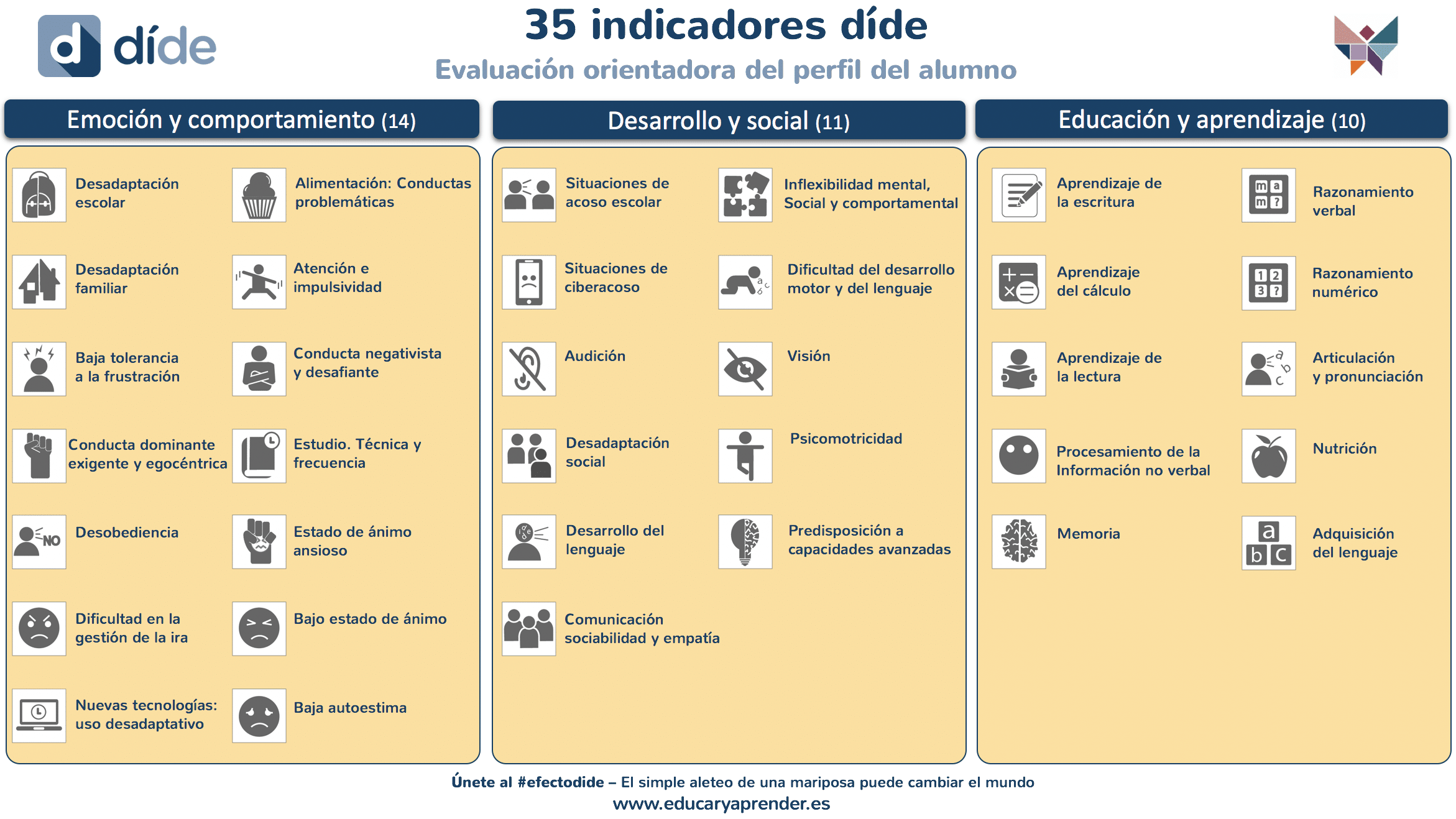
A program like dìde , facilitates a guiding evaluation of the student’s profile for the early detection of low self-esteem, also the option to point out other indicators, up to a total of 35, of various emotional, behavioral, educational and learning as well as developmental and social difficulties, carrying out a convenient and facilitating screening for the success of the development of the minor.

Early detection of learning and development difficulties
