
Guaranteeing equal opportunities in education, a global challenge
There is no doubt that the early detection of difficulties in children facilitates the prevention of problems that interfere with the learning of boys and girls, as well as their development and well-being.
Ignoring these difficulties, whether by the family or the educational system, can lead to negative consequences, including dropping out of school, the loss of the greatest potential and investment of a people, which is that of its children and young people.
However, if that detection is carried out in time, acting with commitment and empathy, the possibility is high of evolving towards life and learning opportunities for minors and their families.
A differentiating factor of every educational center is, without a doubt, the management of diversity in the classroom. To the extent that we are capable of understanding and managing diversity, with the necessary tools, and promoting a curriculum that knows how to connect with the interests of students, we will be able to advance towards a inclusive education with equal opportunities.
Recognition of good practices of the inclusive professional for attention to diversity
It is important to emphasize and recognize the good practices and the role that the teacher, the educational counselor, the management professional and the family play so that these materialize and are points of reference to be applied in other less inclusive contexts.
Researchers such as Mcleskey, Waldron and Redd (2014) state that successful experiences or good practices focus on:
- Knowing the needs of all students (it is the essence and the starting point in education).
- Provide clear instructions
- Constantly reorganize the classroom
- Use resources efficiently
- Be flexible to the needs of students
- Monitor students
- Teachers remain open to suggestions and changes.
However, achieving all these conditions depends on many factors such as the educational system, educational policies, teacher training, the family and the academic culture that leads to alternative ways to promote Inclusive Education. (Study “Good practices in Inclusive Education and the role of the teacher”. Rivero, J).
Some solutions for education for all are “simple”, however, they require teamwork, awareness of the problem and a space for reflection to enable consensus and shared criteria.
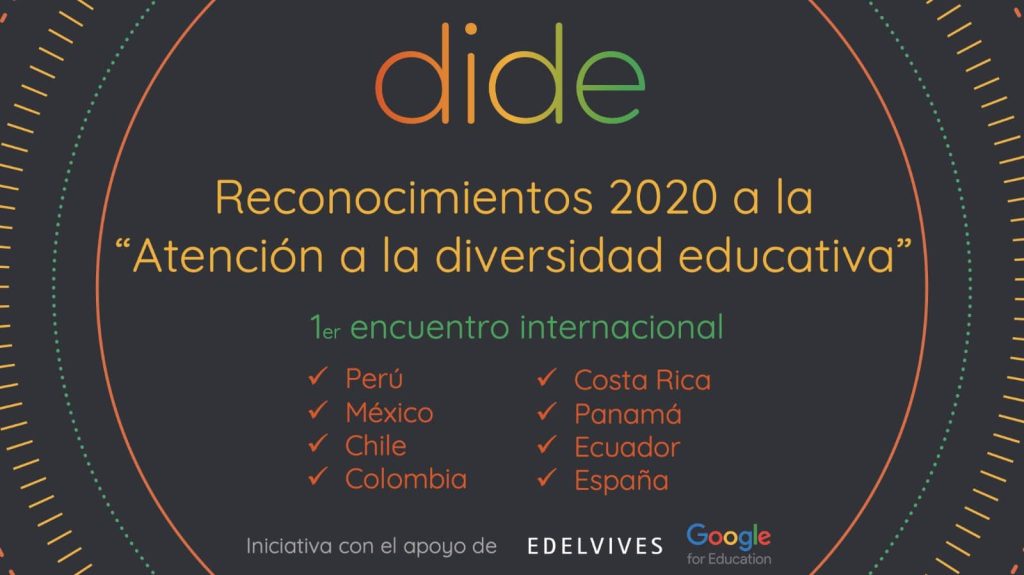
dide (Edelvives) celebrated last Saturday, October 24, an initiative to recognize all those inclusive and innovative educational professionals, protagonists of changes, possessors of professional, ethical, social skills and a renewed leadership, capable of reflecting on their own practice to transform it, permanently update themselves and guide the learning of all their students, respecting their difference and providing them with an education with equity and quality. In short, capable of educating for diversity.
This meeting is the first episode of a series, the first stone of the foundations of a large community of inclusive professionals

I participated in the meeting and, really, very strengthened by listening and sharing with you. How good to meet people who have as their vision to provide a quality education and especially focusing on finding solutions to improve student learning. Thank you dide team. (Percy Eduardo León Díaz, teacher and member of “Ser Maestros”, Peru).
It was excellent. Enriching experience to meet professionals from other countries committed to improving learning, improving the quality of education and who have been using innovative technology to meet their goals and plans. In Peru we are eagerly awaiting the formal launch of the community that was created today. (Guillermo Ortiz, training specialist, Minedu).
Delivery of recognitions to inclusive educational professionals
In addition to the recognition and our admiration for having the student and their educational needs at the central axis of their objective, these professionals will obtain a scholarship for a training course in educational technology and attention to diversity.
- Jaime Montes, leader of the “Ser Maestro” community, Peru
- Patricia Lourdes Grundy Cama, educator, coordinator and manager of the Ser Maestro community, Peru
- Percy Eduardo León Díaz, teacher, member of the Ser Maestro community, Peru
- Lourdes Estela Goycoechea Ludeña, teacher at the Luis Enrique XlX school, Lima
- Oliva Margarita Ita Alvarado, teacher at IE 86563 “San Isidro”, Ancash
- Margarita María Díaz Otoya, support psychologist for the Ser Maestro community, Peru
- María Guadalupe Domingues, professor Ministry of Education/Faculty of Education University of Panama.
- Guadalupe Velásquez Hernández, coordinator of the psychopedagogical center of the International School Querétaro, Mexico.
- Carla Naomi Salbia Lloréns, psychologist representing the Psychopedagogical Cabinet of CEI Giorgeta, Valencia, Spain
- Blanca Iglesias Alonso, general director of ISQ, Mexico
- Rommel Porras González, director and founder of Kamuk School, Costa Rica
- Cristian Secaira, general manager Unidad Educativa Surcos, Ecuador
- Emi Peiró Pérez, director of CEI Giorgeta, Valencia, Spain
- Paquita Escobero Ferreira, counselor at EOEP and president of the Association for Educational Inclusion in Extremadura, Spain.
- Francisca Celedón, partner director of Eduglobal, Chile
- Mercedes Celedón, executive director of Eduglobal, Chile
- Ana María Martínez Restrepo, Operations Manager at Nuvolis, Colombia

Videoconference
The virtual Spanish-speaking meeting on attention to educational diversity
Saturday, October 24
from 5 to 6 p.m. (Spanish peninsular time)
Participants: educational professionals from Chile, Colombia, Mexico, Peru, Costa Rica, Panama, Ecuador and Spain who use technology and carry out inclusive and innovative practices with which they attend to diversity.

REQUEST THE RECORDING OF THE EVENT at info@dide.app
