
More and more schools, associations, and psycho-pedagogical centers are anticipating the needs of children and are committed to preventing problems that interfere with their learning, development, and well-being.
Failure to take these difficulties into account during the child’s growth by family members and the education sector can have negative consequences on their personal, social, and educational development (dropout or school failure). These possible difficulties, detected in time and acting with commitment and empathy, are likely to evolve into life and learning opportunities for the child and the whole family (inclusive education) instead of becoming a difficulty or stigma.
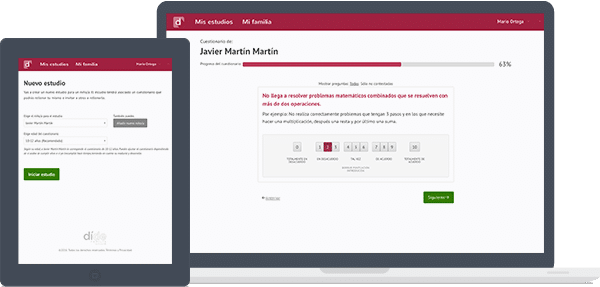
The dide tool to detect possible difficulties and guide families consists of:
- Digital questionnaires (questions to parents and teachers about daily situations with the child)
- Indicators (names of the signs of a possible difficulty)
- Reports: a Prevention Report with the results of the observation, and a Guidelines Report with advice and guided activities with which to actively participate in the proper development of children.
We are going to propose some tips for using and communicating the dide tool that we have collected from the experience of many centers that have introduced dide in their early detection protocol, take it as suggestions and for any questions or concerns you can contact us to discuss it personally.
Recommendations for counselors and teachers who are dide users:
- Good internal communication (to teachers) and external (to families) to explain why the school is already part of the #efectodide (we provide a document to facilitate this information). As well as informing about the innovative methodology, it helps a lot to involve teachers and families in the project.
- Integrate the díde methodology into the school’s current detection protocol. It is highly recommended that both teachers and families become aware that before taking the student out of the classroom to attend the guidance department and be assessed, they will go through a non-invasive díde study that does not affect their daily routine. This decision has multiple benefits for teachers, families, the counselor themselves, and of course, for the child (the child only leaves the classroom if necessary and, if they finally have to go to the guidance team, it will be much faster as they have the information of the alerts detected).
FIRST STEP: dide study to all students through the observation of parents and teachers
SECOND STEP: Reports and results of the study with the identification of students with their educational needs
THIRD STEP: Assessment of cases by the guidance department, and intervention. - Print and laminate the 7 pages of the list of indicators by age groups to have them visible in the guidance department. They are very graphic, families and teachers can visualize all the indicators that can be detected for each age. (download the PDF).

The dide questionnaires take into account up to 35 indicators that interfere with the learning, development and well-being of the child or adolescent
díde is located in the phase prior to diagnosis, automatically collects information from the child’s environment to offer it organized by indicators to the guidance department
- Let’s start using dide selectively before using it “massively”, depending on the type of situation of the school and its way of proceeding:
- The tutors themselves can propose between 3 and 5 students from their class per year who they believe are likely to be observed with díde, without this meaning that during the course they can propose someone else.
- díde also becomes a tool for the tutor themselves. We will be able to provide each tutor with a user with “Tutor” profile so that they are the ones who initiate the relevant studies (they know the children who may be candidates, they know and talk to the families and meet with the rest of the child’s teachers). Tutors can create the studies, which means that they can ONLY see their own díde studies, NOT those of other tutors, but the díde administrator (in this case the counselor or educational counselors of the school) can see everything that all the tutors do.
- At that moment and with the result in hand, it can be decided whether the child finally needs to be assessed by the guidance team or other measures are proposed to continue observing (remember that guidance guidelines are generated to act from the first minute).
- The guidance team receives the filtered students and with the report in which the alerts and discards can be seen, this data gives much more speed to the detection/diagnosis process and therefore, to the intervention.
If the school has one or more internal and full-time educational counselors, the normal thing is that they themselves create the díde studies as proposed by the tutors themselves. But if the school has internal or external and part-time educational counselors, in both cases the “Tutor” profile can be used, in the second case it is more convenient for the tutors to have said profile.
- Díde allows you to do studies to one or several classes of the same age. There are schools that combine the use of díde selectively and massively in the following way:
- They select a course (usually 4-5 years or even 2-3), another age group can be selected according to the educational center.
- And the rest of the students selectively at the discretion of the tutors.
In short:
- Internal and external communication
- Print and laminate the table of indicators to have them visible in the guidance department
- Introduce in the internal protocol of early detection the phase of automatic collection of information with díde (without the intervention of the child)
- Empower the tutor with a new observation and detection tool
Social innovation. Benefits of the dide tool :
- A new service in the school for families
- Dide does not interfere with the child’s routine (We only take the child out of the class if necessary)
- The guidance guidelines act from minute 1 of the identification of the educational need.
- Attention to real diversity
- Less time to reach the diagnosis
- Saving time and costs
Feel that you are part of the #efectodide!