
What do parents want for their children?
With little margin for error, surely the majority answer will be “that they are happy, that they grow up healthy and content”. We can understand that this answer leaves a broad, undefined margin, and by saying everything, nothing is said. Let’s delve a little deeper to get to the heart of the matter.
We will probably also find among the alternatives “that they are a good person, that they know how to defend and assert themselves, that they have the strength to overcome, that they do in life what they want…”, we are already spinning the ball of yarn more finely, but it is still not defined enough.
We want to propose, within the social skills that must be included in education, the importance of assertiveness as essential in all facets of our life. Note, not submission or aggression, but assertiveness.
Assertiveness is the ability to express our thoughts, feelings, and beliefs, assuming them and at the same time respecting the opinion of others without aggression.
In other words, it is essential to know oneself, to have confidence in oneself, as well as empathy to put oneself in the place of the other because, in this way, we will understand the point of view of the other person even if we do not share it.
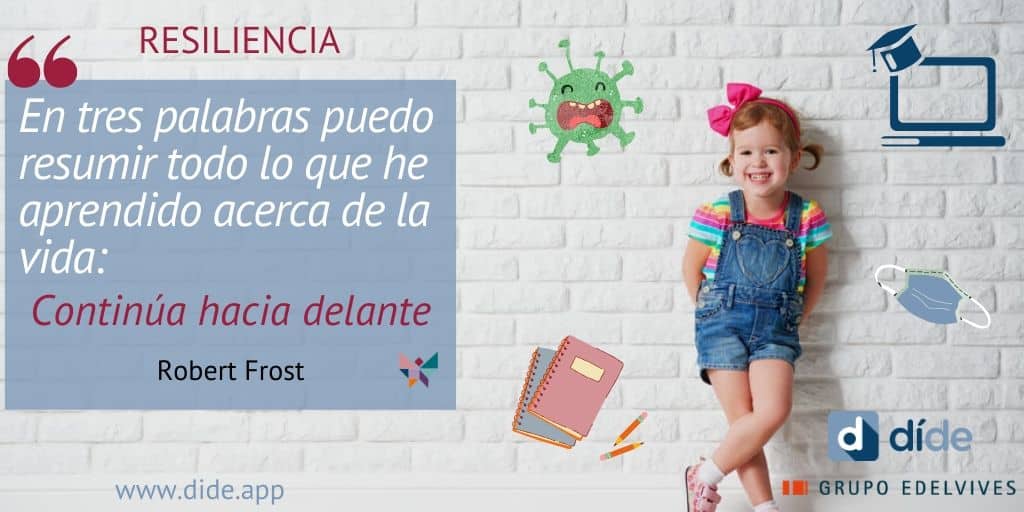
Fostering resilience is possible from childhood; the key is to know their educational needs
Learning and practicing assertive behaviors allows one’s own messages to reach others, expressing opinions and showing consideration. Feelings of security and social recognition are achieved.
The assertive behavior increases self-esteem; as a culmination, assertiveness is based on the respect that entails the freedom to express ourselves respecting others and assuming responsibility for our actions.
Primary resilience is that provided by the first caregivers, generally the parents, through attachment with the child, while secondary resilience occurs later through other people and one’s own experiences.
It is possible to work with education in minors to achieve assertiveness. And we will take another step because what we want is for these children and young people to develop the capacity for reaction and adaptation to adjust to the challenges of the environment, through a constructive and innovative response to adversity, expressed in another way, that they are resilient, that they evolve positively in the face of difficulties, that they adapt to successfully face adversities, and that they are capable of identifying growth opportunities in times of crisis.
The school with proactive resilient education requires teachers who know how to accompany the process of personal evolution of their students and who accept and know how to manage the diversity and complexity of the relationships between the different groups (teachers, students, or families).
Resilience is a learning process that can occur throughout life and, beyond the particularities and diversity of each one, we can all learn to be resilient. The stimulation of cognitive, behavioral, and affective areas from an early age will help in adulthood to the exposure of negative or traumatic events.
Developing good self-esteem and high confidence in oneself and in others are factors that help to achieve the skill of resilience.
According to Suárez Ojeda (1993) …”resilience (from the Latin resilio) means a combination of factors that allow a child, a human being, to face and overcome the problems and adversities of life and build on them.”
Resources and social skills possessed by a resilient minor (Löesel, 1989)
- Stable emotional relationship
- Social support outside the family group
- An open educational climate
- Container and with clear limits
- Has social models
- Has and assumes social responsibilities
- Their cognitive skills, at a minimum, present an average intellectual level
- Has lived experiences of self-efficacy, self-confidence, and maintains a positive self-image
- Their response to stressful situations or factors is one of active coping, empathic capacity, accessibility, and a sense of humor that assigns subjective and positive significance to stress and coping.
A good time to generate opportunity from adversity
At present, we are experiencing a complex and difficult moment caused by a pandemic that affects us at a historical, social, and personal level. There is a clear mark of a before and after generated in a very short time, and even though the damage caused at all levels at the peak of its rise is serious, the consequences it will leave in its wake will be far from negligible. These fears, uncertainties, and the impact of change not only affect adults but also minors absorb them through them, and let’s not ignore social networks, emotions, and situations. With our “feet on the ground” but with a resilient attitude, the same one with which we can teach our children and young people that it is a good time to generate opportunity from adversity.
From dide we support education professionals and families so that you can not only better understand how your children/students are and what they need, but also, in coordination between the school and family environment, be able to adequately address the diversity of minors and their inclusion.
Thanks to the fact that you can learn to be resilient, the sooner you start learning about minors and their educational needs, the sooner they will begin to feel safe and responsible.

Help them be more resilient; they will thank you for it their whole life.
What educational needs can I identify with díde?
