
One of the most frequent problems that emerge in the infant and juvenile population is disobedience and disruptive behaviors in the classroom, which have increased in the last two decades. In a very aseptic sense, to obey is to fulfill the will of the one in charge. Many parents complain that their child doesn’t pay attention to anything, does their own thing, doesn’t listen, and doesn’t care if they are rewarded or punished, and so on, with complaints and grievances everywhere.
In addition to the emotional bond in the family, order and parental authority are necessary, but not authoritarianism.
In the psycho-evolutionary development of infants, the most complex periods in terms of disobedience are those of personal affirmation, that is, the first between two and four years and the next one at the onset of adolescence. Globally, in the first three years of life, the difficulties revolve around sleep and eating habits; from six to nine, non-compliance with rules and studies; and in adolescence, negotiation and communication tactics with a child who is no longer a child but not yet an adult.
Disobeying on occasion is not only normal but healthy; the problem is when it is habitual and even becomes chronic.
There are two pillars in parental education: one is affection and acceptance of the minor as they are with a good dose of tolerance, and the other is authority. Unconditional love is not enough. Let’s understand authority as a quality through which a person has an influence over another, defining influence as prestige, power. The foundation of authority comes from a good affective relationship. If the minor feels gratified by the parents, if they know that they are important to them, a deep and authentic respect, admiration, and even a desire to imitate the parents will emerge from that solid loving relationship on the part of the child.
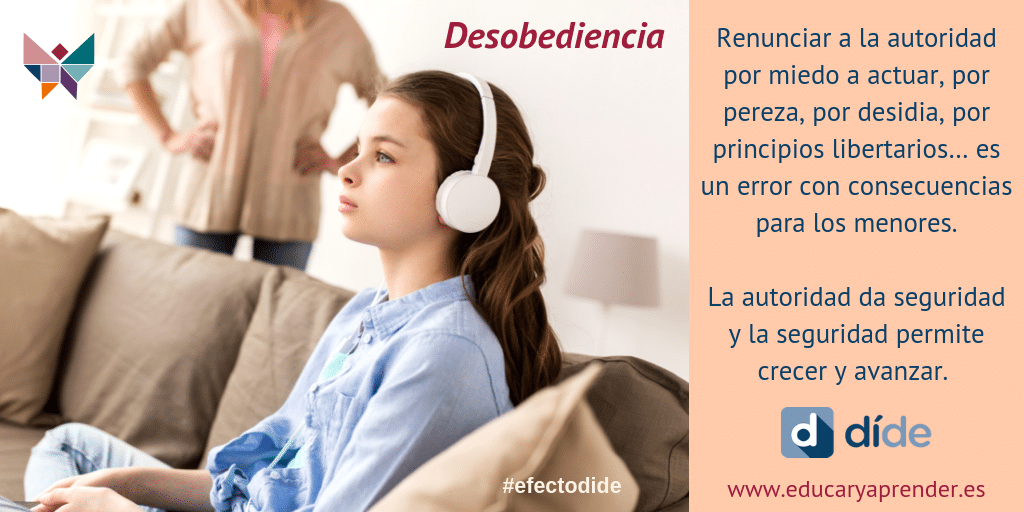
Authority provides security, and security allows growth and progress. It is necessary for educating parents to be aware that they have to enforce what they order.
Authority must be channeled, containing the minor’s overflow. When the child discovers that when they are ordered to do something it is never in vain, and the adult is energetic in enforcing the order given, the child learns to obey. And even if they are upset and frustrated by the setback, they know they are being commanded by a loved one, who is also constant and energetic, which gives them security. They can trust them. The adult gains credit, trust, respect, and even increases their affection. It is not about giving many orders, or making many regulations, or shouting, but about knowing how to give an order and being able to enforce it, without anything in return, neither rewards nor punishments.
Parents have the right and the duty to act with authority before their children. Failure to do so can lead to a negligent attitude towards the child, even to the point where the minor may perceive themselves as abandoned.
Renouncing authority out of fear of acting, out of laziness, out of carelessness, out of libertarian principles… is a mistake with consequences for minors. Giving in for convenience is the easiest thing to do (exercising authority is not comfortable, or easy, or pretty), but it is not the best manifestation of parental love.
Let’s assume that the parents have established an adequate relationship of affection and authority with their child, that the family dynamic is healthy, respectful, and fluid, and yet we find a recalcitrantly disobedient minor; then it will be necessary to assess factors such as age, personality, and possible disorders.
If what we want is for the minor to reduce their disobedient or disruptive behaviors as much as possible, the appropriate thing to do is also to place special emphasis on increasing “desirable” behaviors. Reinforcement is one of the most influential resources when it comes to increasing any type of behavior. However, you have to know how to use it well and not abuse it. The minor must know both the negative consequences of their disobedient behavior and the positive ones of their obedient behavior.
It is essential to explain to children that they should always obey the adults they are left in charge of. Parents must keep their promises and instill routines from an early age. With habits, minors discipline themselves in their activities and, in the same way, learn to obey orders from adults. However, the fact that a child does not comply with an adult’s order does not mean that they are disobedient. Now, if the child is habitually in revolt, they may have a developmental delay, poor language comprehension, attention deficit, or defiant oppositional disorder. If we find that the child is terrible at home and a ‘saint’ at school, or vice versa, education strategies should be reviewed. In one of the places, parenting guidelines are failing.
A child who always misbehaves is a child who has not learned to postpone their gratification, cannot renounce immediate pleasure while waiting for a greater satisfaction that can be achieved through socially accepted means, and is more likely to have low tolerance for frustration.
It is necessary to assess whether the minor is subjected to excessive demands or fatigue, also whether they have gone through a series of experiences that have encouraged bad behavior and have been left with an “impossible” label. Sometimes the minor is receiving an education with discrepant and paradoxical orders.
It is also common to find very busy parents who, for various reasons, do not pay much attention to their child, and in order to get their attention, the minor opposes them, preferring punishment to indifference.
More specifically, there is talk of disobedience behavior when the father, mother, grandfather, teacher… asks the child to perform a behavior and the child does not do it, or begins to do it in a time interval greater than that established. If the child is asked to interrupt their current behavior, or not to start a behavior that is about to occur, and the child does not do so before the set time (20 seconds). Fails to comply with a behavior that has been established by rule. Carries out behaviors that have been explicitly prohibited.
A child treated with indifference or excessive demands is normal to be disinterested, lack motivation, and misbehave constantly. In general, a child who chronically manifests these behaviors is crying out for attention.
Early detection and identification of disobedience and disruptive behaviors
Through the dide methodology, an orienting evaluation of the student’s profile can be carried out for the early detection of disobedience behavior, and the possibility of discriminating other indicators, up to a total of 35, of various emotional, behavioral, educational and learning, as well as developmental and social difficulties, covering ages from 2 to 18 years, performing an effective and facilitating screening for the success of the minor’s development. And all through an automatic, simple, safe and effective system.
Parents also have the possibility of managing this tool at any time when they see that their child has a behavior that they do not understand. Dide familia provides them with information to be able to understand them and seek professional help.


