
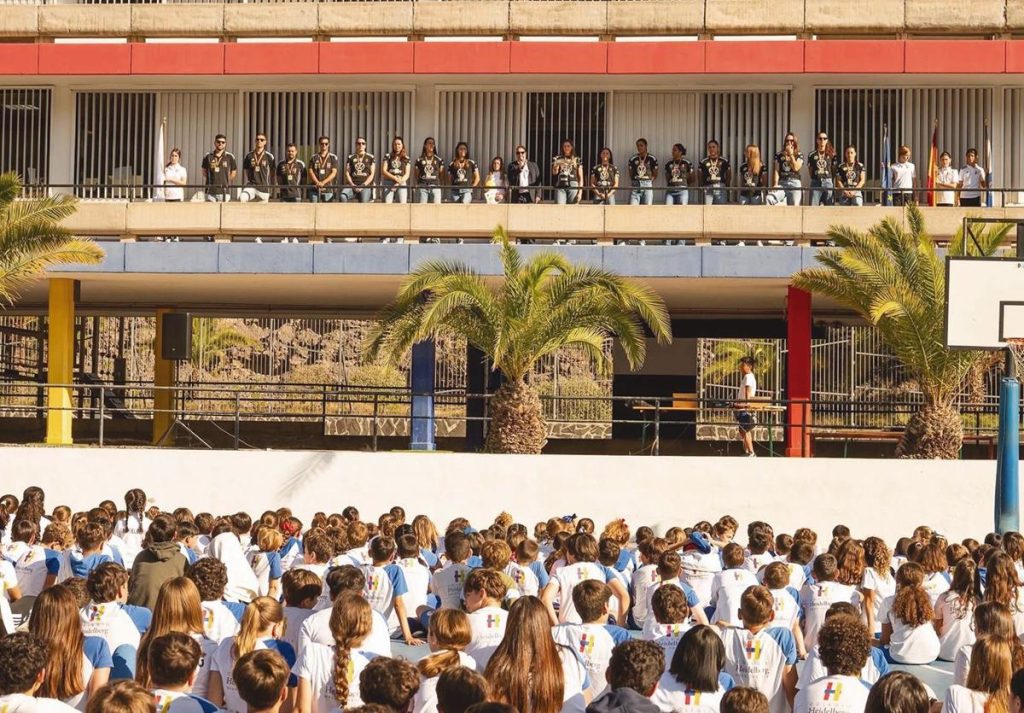
With over fifty years of history, Colegio Heidelberg has established itself as a benchmark in the Canary Islands. Recognized for fourteen consecutive years as the best school in the Canary Islands and ranked among the top twenty schools in Spain, Heidelberg continues to innovate to meet the present and future challenges of the education system.
A course of transformation in the new academic year
This year, under a renewed leadership, the center incorporates a series of strategic transformations with the aim of strengthening its pedagogical model. Among the key focuses is the educational neuroscience project, driven by Dr. Clara García Gorro. This commitment not only brings scientific rigor to the training process but also places research as the engine of educational innovation.
One of the outstanding resources of this new approach is the use of DIDE, which allows for an early, non-invasive, and rapid assessment of the emotional, social, and academic dimensions of students. This tool promotes a comprehensive view of the student and enables timely interventions.
An approach that puts childhood at the center
At Heidelberg, it is understood that each child has their own pace and needs. Therefore, they seek meaningful learning environments that promote curiosity, play, creativity, and critical thinking. Wonder, exploration, and transformation of the environment are drivers of learning.
This respect for childhood also translates into a careful use of technology: although the classrooms are equipped with modern tools—interactive whiteboards, robotics, programming—these are introduced progressively and always linked to purposeful educational projects, avoiding excessive or indiscriminate use in early stages.
How Dide can help other schools
The evolution undertaken by Heidelberg is an excellent example of how an educational institution can integrate innovation, technology, science, and emotional attention to advance towards a more holistic education.
- Early detection: quickly and non-invasively identifies potential difficulties in learning, development, socialization, and behavior.
- Comprehensive view of students: each report gathers strengths and areas for improvement, offering a complete map of the child.
- Participation of the entire educational community: the system collects contributions from teachers and families, creating a shared and more precise view.
- Practical guidance: the results include clear and applicable recommendations in the classroom and at home.
- Prevention and personalization: helps to anticipate problems, personalize teaching, and reduce the inequality of opportunities.
At Dide.org, we firmly believe in this path. Our tool already supports schools throughout Spain and Latin America in the early detection of educational needs, allowing each center to make data-driven decisions and each student to advance according to their own potential.
If your school also wants to take a step towards innovation and comprehensive student care, discover more at dide.org.
