
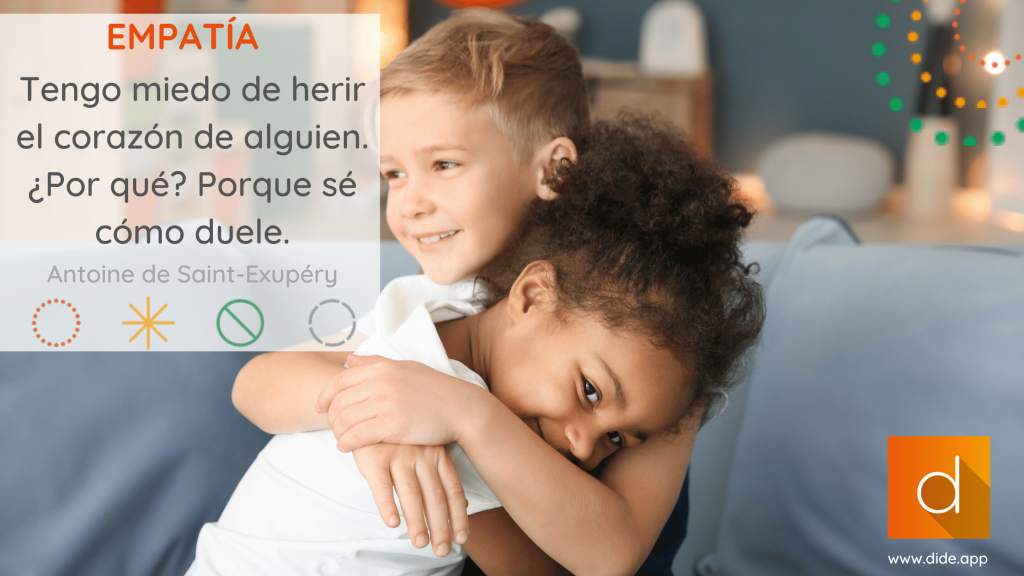
Although it may seem like a very common word, according to the American sociologist Jeremy Rifkin, empathy is actually a very new concept in the vocabulary of any human language spoken until now, and it only began to be used in 1909.
There are other concepts that have been used, such as compassion, altruism, sympathy, but they do not reach the meaning of empathy.
Empathy is the cognitive, emotional, and affective ability of the individual in which they are able to put themselves in the emotional situation of another.
Its origin is from the Greek “empátheia”, it is a capacity or skill that develops gradually throughout life, and that improves the greater the contact one has with the person one empathizes with.
How can we educate our children in developing the skill of empathy?
Children up to the age of two have egocentric empathy. Between the ages of three and four, they begin to show empathy towards the feelings of others. From the final period of childhood and with possible evolution throughout life, empathy towards the vital circumstances of the other is perceived.
In this last phase, the feelings of others are conceived, not only as reactions of the moment, but as expressions of their general life experience. The understanding of feelings goes beyond the here and now, and allows the adoption of other people’s perspectives, however different they may be from one’s own. It depends on the knowledge or information about the lives of other people and the capacity for emotional self-regulation.
Empathy is important to the extent that it motivates prosocial behavior and inhibits aggressive behavior.
Three conditions are necessary for the development of empathy in our children:
- That they have their own positive personal experiences. The child can learn simply by observing the interactions of other people, and the way in which parents relate to the child is of great importance in this. A prior manifestation of empathy towards the child is essential in the formation of empathy.
- That they are aware of their own emotions and feelings. The person who can understand what is happening to them at a specific moment will be able to better understand the feelings of another person. In a small child it is something complex since they cannot even recognize their own feelings and express them, that is why the role of parents is important to help them express what they feel. First, children must recognize their own emotions. To do this, it is very useful to name feelings as often as possible. Identifying emotions is the first step to recognizing them and being able to manage them. Once children begin to know what it is like to be angry, sad, happy, scared, nervous… they can talk about their emotional state and identify the causes that produce it.
There is a very widespread tendency to try to avoid at all costs that children suffer, get bored or cry with phrases such as «don’t cry anymore» or «don’t get angry about that nonsense». Without being aware, what we are doing is prohibiting them from experiencing and expressing their feelings.
All emotions, both positive and negative, fulfill their function and it is necessary to validate them. All of them help us to manifest what we feel, to vent and to express ourselves as human beings.
To learn, grow and evolve, crying is as important as laughter. Children exploring and understanding their own emotions can understand those of others. Only in this way will they learn to behave in a way that they do not have to harm other people (or themselves). It is equally necessary to let them feel the emotion, as it is to provide them with accompaniment without limiting or restricting their process. Learning to regulate emotions is fundamental since, if not, the child learns to regulate emotionally incorrectly, for example, resorting to
others to regulate and calm them. - That they have an understanding of what the other person feels. The last stage consists of being aware of what another person “may” feel. Empathy is not possible if you do not know exactly what the other person feels, that is why it is important to talk to our children, and that the various situations that arise in life are discussed, or even a peculiar situation that we have seen in a movie, on a television program…
Children learn from what they see, it is convenient that as adults we develop our empathy and show it to the little ones
The values and the way of acting of the closest adults are transmitted to children without us realizing it.
- Educate them to grow with a healthy and strong self-esteem, this will allow them to put themselves in the place of others without feeling vulnerable or being harmed by erroneous interpretations.
- Invite them to actively listen to others, to identify what others feel, what they think, what makes them happy, what makes them sad, what they fear…
- It is necessary that we talk to them and explain our emotions and feelings. In this way they will understand that in the face of the same situation others also have thoughts and emotions different from one’s own.
- Teach them to pay attention to others. When another person speaks, we will listen carefully, they will learn
that this is what should be done and we will encourage them to listen and look at the person.
The benefits of working and educating empathy in children from the first moment in a better expression of their feelings will make them less aggressive, will help them to avoid and solve possible conflicts. They will communicate and relate better with their environment.
It will favor global well-being since it will make it easier for them to understand certain behaviors of others. Educating in empathy is overcoming what Freud called “primary narcissism” of the baby and that this pathological and tyrannical narcissism is not perpetuated in the adult. For this, both early detection and intervention with the minor are necessary, if possible from moment zero.
Detecting the profile or map of characteristics of the minor
The díde educational platform allows us in a simple, fast way and without the intervention of the minor to obtain all the information of the main areas of the child (Education and Learning, Development and Social, Emotion and Behavior) developing a profile of how they are and what they need.
Let’s act in time, parents and teachers, we have the ideal tool to know what to do with the child, and among so many other aspects, to nullify from today the aggression and violence that could manifest tomorrow.
Do you want to know the educational needs of your children/students?
