
This new approach should begin with the diagnosis and early treatment of learning dysfunctions in schools.
The Senate Education and Sports Committee has approved a motion by the Popular Parliamentary Group, which has been transacted, proposing different measures to combat school failure, one of the main challenges of the education system, according to the senator for Castilla y León, Ignacio Cosidó, who stressed that “this new approach should begin with the diagnosis and early treatment in the school itself of learning dysfunctions, such as Attention Deficit Hyperactivity Disorder (ADHD) or dyslexia.” These learning disorders are, in many cases, the origin of this failure.
Cosidó, who defended this initiative in the Committee, pointed out that “the motion presented by the Popular Group not only urges to intensify resources, priority and attention, but also calls for a change of strategy towards a more comprehensive response to this problem of school failure and that contemplates, in addition to factors such as teachers, family and social, the treatment of learning disorders.”
School failure is not due to poor quality schools, unmotivated or unprepared teachers, families who do not care about their children’s education, or social problems. In many cases, it originates in certain learning disorders that, if properly detected and treated, can give very positive results. (Ignacio Cosidó)
Despite the reduction of the school failure rate by more than eight points since 2011, there is still work to be done to reach the target of lowering it to 15% set by the European Union for 2020.

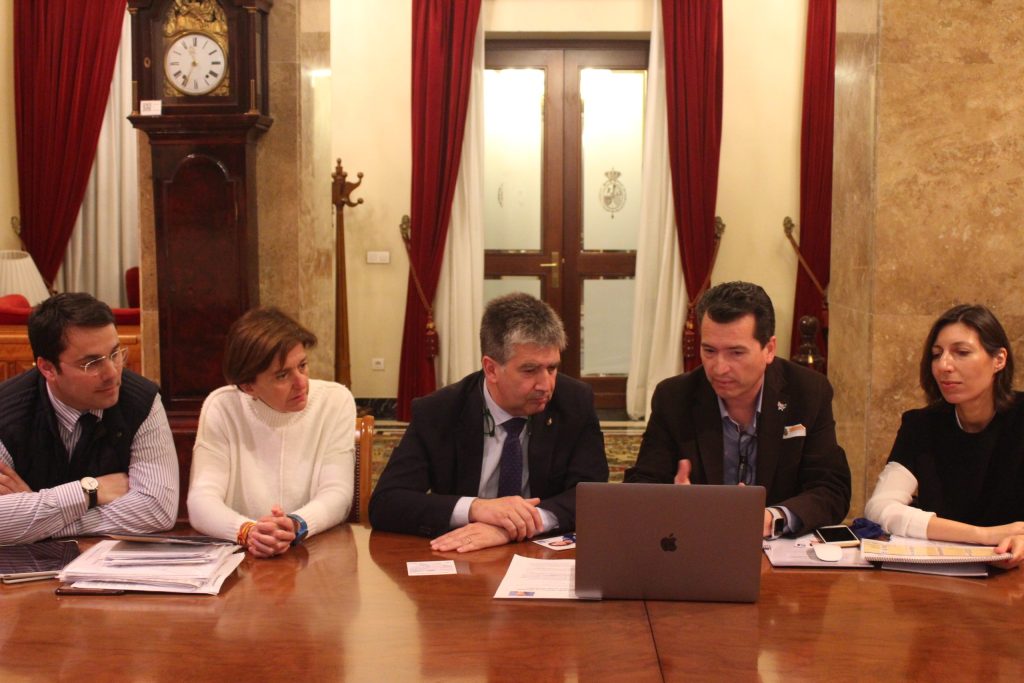
Presentation of the dide method to Ignacio Cosidó and the team of the Senate’s Education and Sports Committee
With these objectives in mind, the management of dide contacted Ignacio Cosidó and the Senate Education and Sports Committee to present the educational project díde, which allows to identify in a very short time the learning, development, behavioral and emotional difficulties that can affect a minor, all without their intervention and only through digital questionnaires answered by parents and teachers. This pioneering early detection platform, created by the Valencian company Grupo VS, automatically collects information from the child’s environment, facilitating a global vision of the profile of children and adolescents from 2 to 18 years old in order to intervene as soon as possible.
It does so through 35 indicators that influence the learning, development, emotion and behavior of the minor and that allow to know their real needs and carry out the evaluation and diagnosis. These are indicators such as school or family maladjustment, low tolerance to frustration, attention and impulsivity, defiant behavior, disobedience, low self-esteem, bullying or new technologies. Also dyslexia, dyscalculia, asperger, autism…
Ignacio Cosidó and his team were able to learn about the functionalities and characteristics of this system as well as the benefits it brings in favor of equal opportunities for all children.

It is about identifying the real needs of the students, not only looking for ADHD or Dyslexia
Alberto Ramírez, director of the díde project, explained that “it is not necessary to focus on looking for the indicators with the highest incidence, ADHD or Dyslexia. There is a wide variety of factors and comorbidities (disorders associated with the main one) that can influence the child’s learning, development and well-being, including high abilities. It is about identifying the real needs of children so that psychoeducational professionals can help them with an adequate and timely intervention”.
For the first time, education officials and schools will have their ‘bigdata’ available to take educational measures in real time according to the needs of their students.
Project endorsed by psychoeducational institutions and professional experts
Enrique Celma, director of the community of teachers of Microsoft Education Spain, attended the meeting together with Alberto Ramírez. Microsoft makes its platforms and services such as Azure and Power BI available to dide to help meet technical needs, reaching the educational community more and better.
This project is endorsed by the official associations of psychology, pedagogy and psychopedagogy of the CV, the Junta de Extremadura, the Ministry of Education of Castilla y León, the Spanish Association of Private Education Centers (ACADE), the Confederation of Organizations of Psychopedagogy and Guidance of Spain (COPOE) and Microsoft Education in Spain. Dide has a technical advisory team formed by professional experts in education and psychology who collaborate by contributing knowledge in the scientific and methodological part.
The professionals who have used the tool tell us that they find it a very good detection instrument, that they see great possibilities and that it can be of immense help.
We trust that this first contact and the possibility offered by dide for the early detection of the needs of children will be the beginning of a fruitful process, always with the aim that our minors are valued and supported in their singularity and participants in a inclusive education. (Alberto Ramírez)
EARLY DETECTION OF LEARNING AND DEVELOPMENT DIFFICULTIES FROM 2 YEARS OF AGE
Source: Redacción Médica
Main image: Ignacio Cosidó, spokesman for the Popular Parliamentary Group; Senate Education and Sports Committee: Ángeles Muñoz, Head of Cabinet of Ignacio Cosidó and Ana González, Education Spokesperson within the Education and Vocational Training Committee in the 12th legislature; Alberto Ramírez, director of dide and Enrique Celma, director of the community of teachers of Microsoft Spain.